Dog agility can greatly enhance the bond between owner and dog, and many agility handlers find training and competing quite addictive! Equipment can be expensive, but foundation and early training can happen in a large room of the home or a backyard with a few homemade jumps, a weave poles set, and perhaps a tunnel.
More advanced training requires that you can build a dog agility course to practice on. That means more equipment and longer, more complicated courses that need more space. Often, this kind of training takes place in dog-training facilities. You can absolutely start the sport on a budget, however. Most of us did!
How to Choose Safe Dog Agility Equipment
There are several categories of agility equipment, including jumps, weave poles, tunnels, tire jumps, a pause table, A-frame, dogwalk, teeter (or seesaw), and variations of jumps, like broad jumps and walls. You do not need everything, especially if you have facility where you can train, like a dog club or a lesson facility. What you do need is safe equipment for both you and your dog.
Recommended Agility Jumps
The greatest percentage of agility obstacles on any competition agility course are jumps. Jumps include sides with or without wings (wider sides built onto the jumps), a panel jump (a slat-type jump that looks like a solid barrier), and spread jumps of two poles (called a “double”) to three poles (called a triple) that require the dog be able to clear some horizontal distance. You may also see broad jumps (low, wide obstacles) and a wall jump, which appears solid and is wider than the panel jump. In some venues, you may encounter a table obstacle or a tire jump.
My Favorite Jumps: M.A.D. Agility has colored jump cups for each bar height, which makes it easy to set the bars correctly. I also have these jumps in my backyard because the weight the interior of their jumps to give their stanchions even more stability, even in windy conditions. Jumps run $150 to $400.
Budget Jumps: If you have access to basic tools, a store that sells PVC piping and fittings, and some elbow grease, you can build your own jumps. Jump cup strips are available through Clip & Go Agility, and they generously offer plans for wing and wingless jumps on their website.
My Favorite Agility Contact Equipment
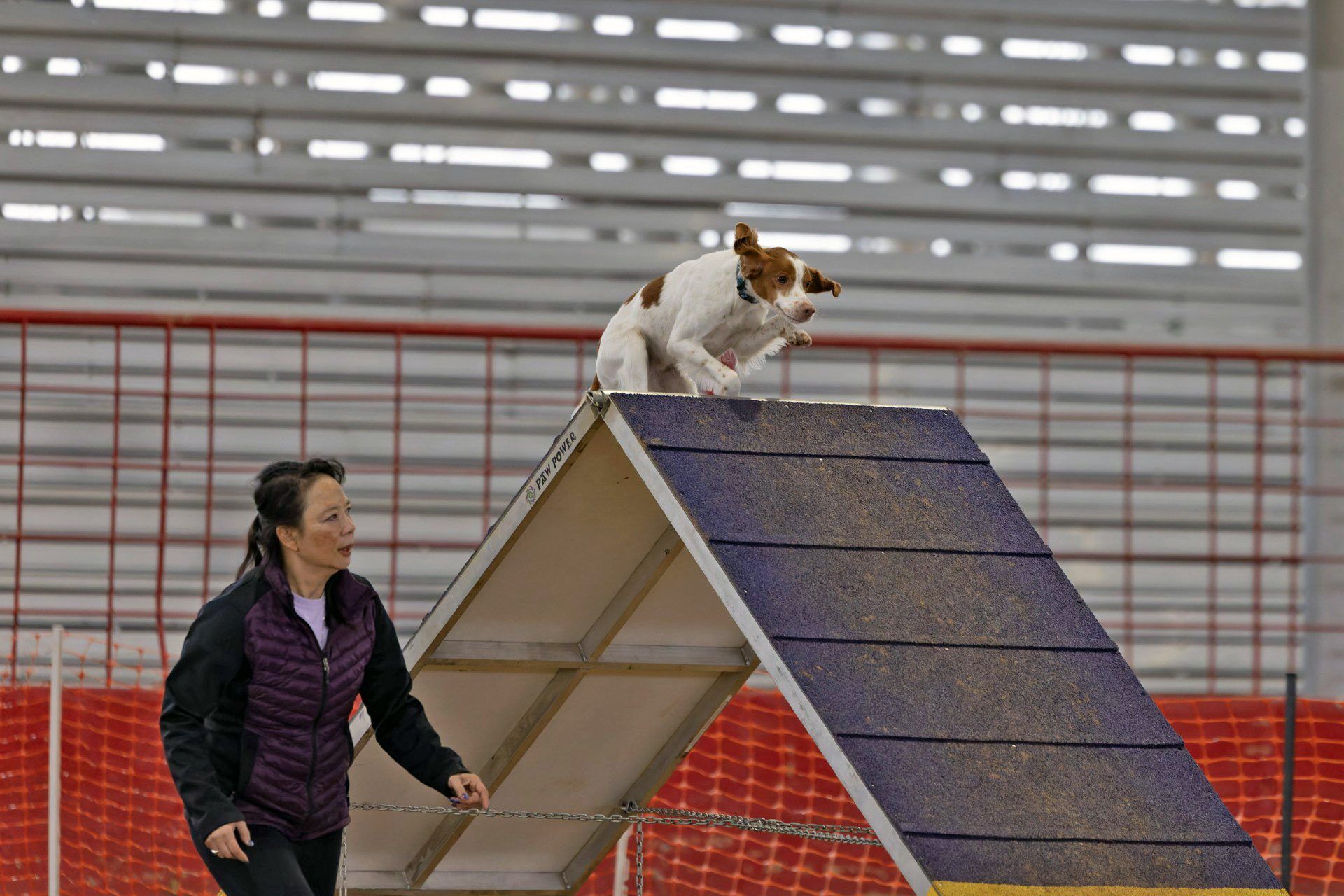
This group of agility obstacles are the largest, heaviest, and most expensive. Contact equipment includes the A-frame, the dogwalk, and the teeter. Their correct performance requires the dog to place at least a portion of a paw in an end zone (usually defined by a contrasting color) at the end of the obstacle, demonstrating a controlled exit.
I am a fan of the Galican A-frame ($2,500 and available to ship to the USA through Run-It Ultimate Dog Agility Equipment in Canda) because it can be put on furniture sliders to move over turf, making course changes easy.
The Clip & Go dogwalk ($2,900) is my favorite dogwalk because it’s propped on wheels, and either end of the contact can easily be raised/lowered, making course changes easy. There is also little-to-no bounce to any part of the dog walk for even fast large breed dogs.
Any contact equipment in my backyard must have wheels for ease of course building and moving equipment to mow grass. Max 200, Clip & Go, and Galican have wheels either standard or can be added to an order. There are also A-frame movers that can be retrofitted to an A-frame without wheels. The Clip & Go dog walk, already on wheels, easy to move.
For the teeter, I like the Clip & Go teeter ($1,300) because of the speed-limiting cylinders on the base that help to reduce board bounce and whip as the end hits the ground, reducing chance of obstacle-related injury to the dog. But Max 200 ($600 to $650) is an excellent price and its board is sturdy. Plus, the height is easily adjustable for training. I suggest you spring for the M.A.D. Agility’s Teeter Tote ($115), if you can. It makes moving a teeter easier in the backyard.
Budget Contacts: There are DIY plans for teeter bases. Most DIY agility enthusiasts don’t make their own contact equipment for higher level training because of equipment size, weight, and safety concerns. If the dog is a large or giant breed, training on equipment that meets the standards of one of the national organizations is recommended to make sure the equipment can handle the forces the dog will place on it.
That being said, one of the most useful pieces of equipment for foundation or maintenance contact training is a travel plank, such as the one from Clean Run ($140). It’s also available through most agility equipment suppliers (consider an “add on” purchase!) or can be pretty simply built yourself.
My Favorite Tunnels
Tunnels are fun! Also known as “puppy cannons” because most dogs fly through them, tunnels can vary in length between 20 feet to as short as 3 feet for training.
What I love to compete on: Clip & Go tunnels ($260 to $600) because of their sturdiness. Their tunnel bags ($50 to $75) are also a favorite of mine for design in handling the heavy, weighted bags that help keep tunnels in place while a dog is running through it (an absolute necessity).
What I have in my backyard for training are Max 200 tunnels ($230 to $540) because they’re a good price and high quality.
Budget tunnels: Be careful. I am not a fan of lightweight tunnels. My first agility dog ran through one of these and only made it halfway before he became a tangled mess of dog, nylon, and wire. Thankfully, he was not injured, but it scared me. Try to purchase the best tunnels you can afford.
My Favorite Weave Poles
Weaves are one of the hardest agility obstacles to learn. Most agility enthusiasts who compete even on a local level have weave poles at home to train.
What I love to compete on: M.A.D. Agility or Max 200 because they provide equipment for most national events, and dogs can become very accustomed to the pattern of the weave pole bases. Expect to pay around $500 for weave poles, give or take.
In my backyard, I have several sets of weave poles. My 2×2 weave pole bases allow one to create exercises for a short run of poles (i.e., 4 to practice entrances without excessive wear and tear on the dog) and a full set of 12 as long as one has 6 bases. An economical source of 2 x 2 weaves is Mark’s Agility Equipment.
Budget weaves: Stick-in-the-ground weave poles are ideal for beginners. J&J Dog Supplies can supply the bases and you can also purchase a ground strip with grommets every 24 inches to stick the spike of the stick-in-the-ground weave pole through to ensure proper spacing.
The Best Pause Table
The pause table is used less than in the past, but it does require some training to ensure correct performance.
What I love to compete on: M.A.D. agility pause table because of the rubberized top, durability, and a compact table leg caddy that helps to keep all those not-in-use legs organized.
In my backyard, I have the Max 200 pause table with rubberized top and PVC base ($350). My dogs are all the same breed and use the same size table, so height switches are not necessary for me.
If you’re on a budget, like most of us when we started out, you can save some money here. I built my first agility pause table, and it did double as my coffee table when not in use! Clean run has a nice PDF on how to do it.
Final Thoughts on Agility Equipment
When considering purchasing or building agility equipment to train on, it’s important to consider the equipment standards for each organization you might compete in, assuming you plan to compete. For example, requirements for the height and length of the dogwalk, or the length of the boards for the A-frame can vary among agility organizations. Thankfully, for training purposes, there is quite a bit of overlap between most of the agility organizations:
- American Kennel Club (AKC)
- Canine Performance Events (CPE)
- North American Dog Agility Council (NADAC)
- Teacup Dogs Agility Association (TDAA)
- UK Agility International (UKI)
It is possible to save money on quality agility equipment by pre-ordering and picking up new equipment at a national event or other large show, or committing to purchase equipment used for the event (slightly used). Equipment suppliers are often listed in the event premium.
Good used equipment can also be found online at sites such as Facebook Marketplace or Craig’s List. Sometimes dog training clubs sell used equipment as they upgrade equipment for competition. Again, when purchasing used equipment, consider the equipment specs for the organization you compete in most, as well as the condition of the equipment, keeping your dog’s safety in mind.